
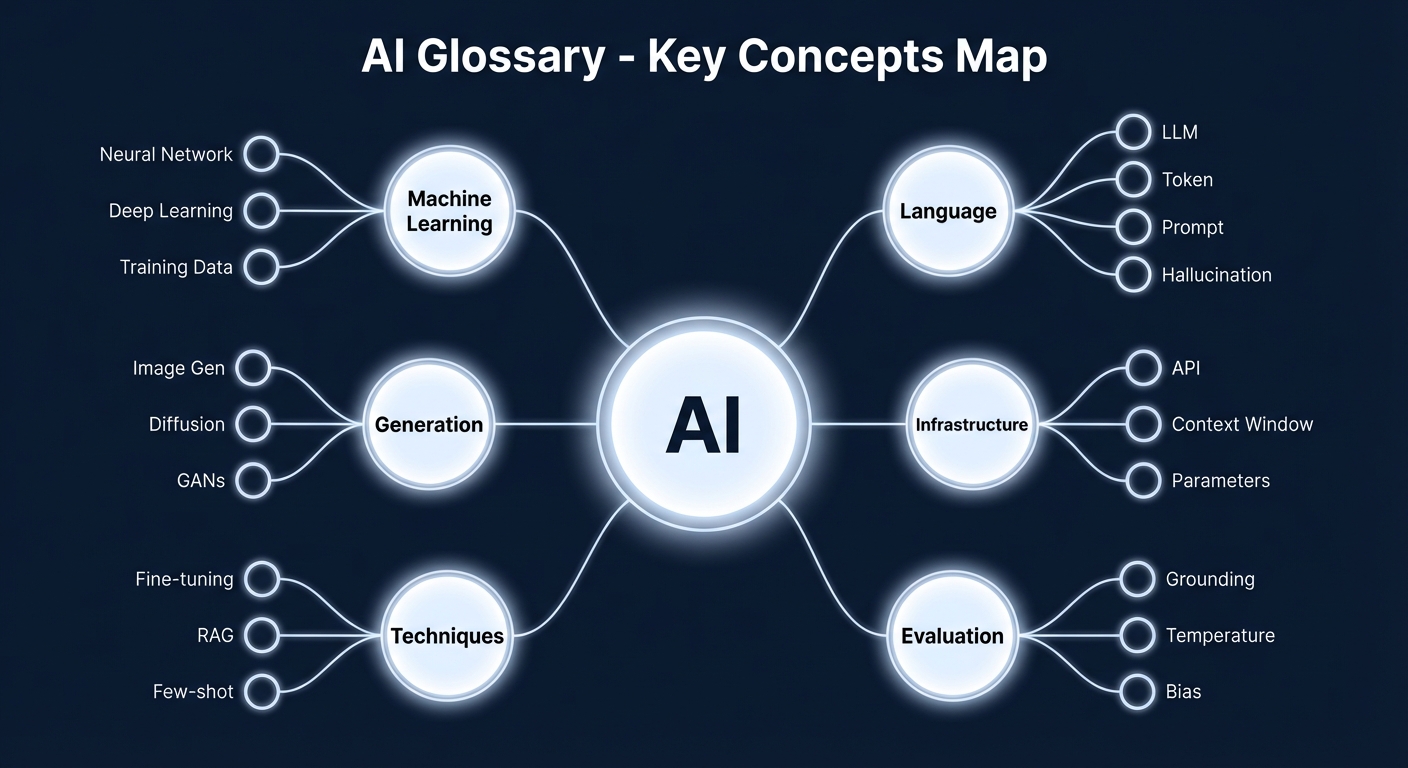
Every AI term explained in plain language. From 'algorithm' to 'zero-shot learning'. Quick reference for anyone encountering AI terminology.
A hypothetical AI system that can understand and learn any intellectual task a human can. Current AI systems are 'narrow' -- they excel at specific tasks but cannot generalize across all domains the way humans do. AGI does not exist yet, despite marketing claims.
A set of step-by-step instructions that a computer follows to solve a problem or complete a task. Think of it as a recipe: specific inputs go in, specific steps happen, and a result comes out. Every AI system runs on algorithms, but the term itself is much broader than AI.
A way for two pieces of software to talk to each other. When you use an AI tool through a website, it sends your request to an API behind the scenes. APIs let developers build apps on top of AI models without needing to run the model themselves.
The broad field of computer science focused on creating systems that can perform tasks that typically require human intelligence. This includes understanding language, recognizing images, making decisions, and learning from experience. In daily use, 'AI' usually refers to machine learning systems like ChatGPT or image generators.
A technique that lets AI models focus on the most relevant parts of their input when generating a response. Just like you pay more attention to certain words in a sentence to understand its meaning, attention mechanisms let models weigh which words or data points matter most. This is the core innovation behind Transformers.
Systematic errors in AI output caused by skewed or unrepresentative training data. If a model is trained mostly on English text, it will perform worse in other languages. If hiring data reflects past discrimination, the AI may replicate that discrimination. Bias is one of the biggest challenges in responsible AI development.
A software program designed to simulate conversation with humans. Simple chatbots follow scripted rules ('if the user says X, reply Y'). Modern AI chatbots like ChatGPT and Claude use large language models to generate responses dynamically, making them far more flexible but also capable of producing incorrect answers.
An AI assistant made by Anthropic. Claude is a large language model known for its focus on safety and helpfulness. Available in different versions (Haiku, Sonnet, Opus) that trade off speed versus capability. Used for writing, analysis, coding, and conversation.
The field of AI that teaches computers to interpret and understand visual information from the world: photos, videos, and live camera feeds. Applications range from facial recognition to medical image analysis to self-driving cars recognizing pedestrians and traffic signs.
The maximum amount of text (measured in tokens) that an AI model can process in a single conversation. Think of it as the model's short-term memory. A larger context window means the model can consider more information at once. Current models range from 8,000 to over 1,000,000 tokens.
An AI image generation model created by OpenAI. You describe what you want in plain text, and DALL-E creates an image matching that description. Named as a blend of the artist Salvador Dali and the Pixar robot WALL-E. It was one of the first widely available text-to-image systems.
A subset of machine learning that uses neural networks with many layers (hence 'deep'). These extra layers allow the model to learn increasingly complex patterns. Deep learning powers most modern AI breakthroughs: language models, image recognition, speech synthesis. It requires large amounts of data and computing power.
A type of AI model that generates images by starting with random noise and gradually removing it until a clear image forms. Think of it as sculpting: you start with a block of marble (noise) and chip away until a statue (image) appears. Stable Diffusion, DALL-E, and Midjourney all use variations of this approach.
A way of converting text, images, or other data into a list of numbers (a vector) that captures its meaning. Words with similar meanings end up close together in this number space. Embeddings are how AI models understand relationships between concepts and are the foundation of semantic search and recommendation systems.
When you give an AI model a few examples of what you want before asking it to do the task. For instance, showing it three example product descriptions before asking it to write a fourth. The model uses these examples to understand the pattern you want without needing to be retrained.
Taking a pre-trained AI model and training it further on specific data to make it better at a particular task. Like a general doctor specializing in cardiology -- the base knowledge stays, but the model becomes an expert in a narrower area. Companies fine-tune models on their own data to get better results for their use case.
A large AI model trained on broad data that can be adapted to many different tasks. GPT-4, Claude, and Gemini are foundation models. They are not built for one specific purpose but serve as a starting point that can be fine-tuned or prompted to do almost anything with text, code, or images.
Two neural networks competing against each other: one generates fake content (the 'generator'), the other tries to detect if it is fake (the 'discriminator'). This competition makes both better over time. GANs were the dominant approach for AI image generation before diffusion models took over.
Google's family of AI models. Gemini is multimodal, meaning it can process text, images, audio, and video in a single conversation. Available in different sizes (Flash, Pro) and integrated across Google products like Search, Workspace, and Android.
OpenAI's series of large language models. 'Generative' means it creates new text, 'Pre-trained' means it learned from massive amounts of data before you use it, and 'Transformer' is the architecture it is built on. GPT-4 powers ChatGPT. The term is sometimes incorrectly used as a generic name for all AI chatbots.
Connecting an AI model's output to verifiable, real-world information sources. Without grounding, models generate text based on patterns in training data, which can lead to hallucinations. Grounding techniques include RAG (connecting the model to a database) and web search integration to anchor responses in facts.
When an AI model generates information that sounds confident and plausible but is factually incorrect or entirely made up. The model is not lying intentionally -- it predicts the most likely next words based on patterns, and sometimes those patterns lead to fiction. This is why you should always verify AI-generated facts.
Using AI to create new images from text descriptions (prompts). You type what you want to see, and the model produces an image. Major tools include DALL-E, Midjourney, and Stable Diffusion. Quality has improved dramatically since 2022, but results still require careful prompting and iteration.
The process of an AI model generating an output from an input. When you ask ChatGPT a question and it responds, that response generation is inference. Inference is separate from training: training builds the model, inference uses it. Inference speed and cost are major factors in AI product pricing.
An AI model trained on vast amounts of text data that can understand and generate human language. 'Large' refers to the billions of parameters (learned values) inside the model. GPT-4, Claude, Gemini, and Llama are all LLMs. They work by predicting the most likely next word in a sequence, billions of times over.
A branch of AI where computers learn patterns from data instead of being explicitly programmed with rules. Instead of telling the computer 'if email contains these words, it is spam', you show it thousands of spam and non-spam emails and let it figure out the patterns itself. Most modern AI systems are built on machine learning.
An AI image generation service known for producing highly artistic and stylized images. Originally accessible only through Discord, it now has a web interface. Midjourney is popular for creative and commercial visual work due to its distinctive aesthetic quality.
In AI, a model is the trained system that takes input and produces output. It contains the patterns learned from training data, stored as mathematical weights. When people say 'GPT-4 is a model', they mean it is the trained system that processes your questions. A model is the product of training, not the training process itself.
An AI system that can work with multiple types of data: text, images, audio, and video. GPT-4, Gemini, and Claude can all process both text and images in the same conversation. This is a step beyond text-only models and enables tasks like describing photos or analyzing charts.
The field of AI focused on enabling computers to understand, interpret, and generate human language. NLP covers everything from spell-checking and translation to chatbots and sentiment analysis. LLMs represent the current state of the art in NLP.
A computing system loosely inspired by the human brain. It consists of layers of connected nodes ('neurons') that process information. Data enters through the input layer, passes through hidden layers that transform it, and exits through the output layer. Neural networks are the building blocks of deep learning and modern AI.
The company behind ChatGPT, GPT-4, and DALL-E. Founded in 2015 as a nonprofit, it has since restructured with a for-profit arm. OpenAI popularized large language models for the general public with the launch of ChatGPT in November 2022, which became the fastest-growing consumer application in history at that time.
AI models whose code and/or weights are publicly available for anyone to use, modify, and distribute. Meta's Llama and Mistral are prominent examples. Open source models let companies run AI on their own servers, giving more control over data privacy and costs, but require technical expertise to deploy.
The internal values that an AI model adjusts during training to learn patterns from data. Think of them as knobs the model tunes to get better at its task. More parameters generally means the model can learn more complex patterns. GPT-4 is estimated to have over a trillion parameters. The number alone does not determine quality.
The text input you give to an AI model to tell it what to do. It can be a question, an instruction, or a combination of context and task. The quality of your prompt directly affects the quality of the output. A vague prompt gets a vague answer; a specific, well-structured prompt gets a precise result.
The practice of crafting and refining prompts to get the best possible output from an AI model. This includes techniques like giving the model a role ('You are an expert copywriter'), providing examples (few-shot), breaking complex tasks into steps (chain-of-thought), and specifying the desired output format.
A technique that combines an AI model with an external knowledge source. Before generating a response, the system first retrieves relevant information from a database or document collection, then uses that information to produce a more accurate answer. RAG reduces hallucinations because the model has actual data to reference rather than relying on memory alone.
A training method where an AI learns by trial and error, receiving rewards for good actions and penalties for bad ones. Like training a dog with treats: correct behavior is reinforced. RLHF (Reinforcement Learning from Human Feedback) is a specific form used to make chatbots more helpful and less harmful by having humans rate their responses.
Using AI to determine the emotional tone of a piece of text: positive, negative, or neutral. Businesses use it to analyze customer reviews, social media mentions, and support tickets at scale. Modern LLMs can detect nuanced sentiments like sarcasm, frustration, or cautious optimism.
An open-source AI image generation model developed by Stability AI. Unlike DALL-E or Midjourney, anyone can download and run Stable Diffusion on their own computer for free. This openness has created a massive community of custom models, add-ons, and specialized tools built on top of it.
Hidden instructions given to an AI model before your conversation begins, set by the application developer. It defines the model's behavior, personality, and boundaries. For example, a customer service chatbot might have a system prompt saying 'You are a helpful support agent for Company X. Never discuss competitors.' You typically cannot see or change the system prompt.
A setting that controls how random or creative an AI model's output is. Low temperature (close to 0) makes the model pick the most likely words, producing predictable and factual responses. High temperature (close to 1 or above) introduces more randomness, making output more creative but also less reliable. Use low for facts, high for brainstorming.
The basic unit of text that AI models process. A token is roughly 3/4 of a word in English: 'artificial' is two tokens, 'AI' is one. Models read, process, and generate text token by token. Pricing and context window limits are measured in tokens. Understanding tokens helps you estimate costs and work within model limits.
The dataset used to teach an AI model. For LLMs, this typically includes books, websites, articles, and code -- often hundreds of billions of words. The quality, diversity, and size of training data directly determine what the model knows and how well it performs. Training data also determines what biases the model may have.
The neural network architecture that powers most modern AI language models. Introduced by Google researchers in 2017, its key innovation is the attention mechanism, which lets the model consider all parts of the input simultaneously rather than processing it word by word. GPT, Claude, Gemini, and Llama are all built on the Transformer architecture.
A specialized database designed to store and search embeddings (vectors). Instead of searching by exact keywords, vector databases find items by meaning. If you search for 'happy', it also finds entries about 'joyful', 'elated', and 'cheerful'. They are essential for building RAG systems and semantic search applications.
The numerical values inside a neural network that determine how it processes information. During training, these weights are adjusted millions of times until the model produces accurate outputs. When someone says they 'downloaded a model', they mean they downloaded its weights. The weights encode everything the model has learned.
When an AI model performs a task it was never specifically trained on, without any examples. You simply describe what you want, and the model figures it out from its general knowledge. For example, asking a model to classify customer complaints into categories without showing it any examples first. This ability is what makes modern LLMs so versatile.