
Real use cases, realistic ROI expectations, common pitfalls. Written by someone who uses AI daily in operations, not someone selling AI services.
I have been working in container logistics for 18 years. I use AI tools daily in my actual work. Not as a demo, not as a proof of concept, but to solve real operational problems. That gives me a perspective most AI articles lack: I know what it is like when a tool breaks mid-shift, when the data is messy, and when your colleagues look at you like you are speaking Martian.
So here is the honest version: AI is genuinely useful for business. But it is not magic, and it will not replace your workforce overnight. According to 2025 adoption data, about 58% of small businesses now use some form of generative AI, up from 40% in 2024. That is a fast adoption curve, but it also means roughly 4 out of 10 businesses have not started yet. And of those who have, many are still experimenting without clear results.
The gap between large enterprises and small businesses is closing fast. In early 2024, large companies used AI at nearly twice the rate of small ones. By mid-2025, that difference had nearly disappeared. The tools have become accessible. The question is no longer whether you can afford AI. It is whether you can afford to implement it poorly.
Forget the futuristic promises. These are the areas where AI delivers measurable value right now, with tools you can set up this week. I have used all of these in practice.
AI chatbots handle routine inquiries 24/7 while routing complex issues to humans. Not the clunky chatbots from 2019. Current models understand context, maintain conversation history, and can escalate intelligently. Businesses report 40-70% efficiency gains in first-line support. The key: train it on YOUR data, not generic FAQ templates.
Invoices, contracts, shipping documents, compliance reports. AI extracts data from unstructured documents with 70-90% time reduction compared to manual processing. In logistics, I see this daily: bills of lading, customs declarations, damage reports. The hours saved are real and measurable. Works best with consistent document formats.
Summarizing reports, finding patterns in spreadsheets, creating dashboards from raw data. AI turns hours of analyst work into minutes. The catch: it is only as good as your data. If your spreadsheets are a mess, AI will confidently analyze that mess and give you polished garbage. Clean data first, then automate.
Product descriptions, social media posts, email templates, internal documentation. AI handles the first draft so your team focuses on strategy and review. This is where most businesses start because it is low-risk and results are immediate. Just do not publish AI output without human review. Your brand voice matters.
For every success story, there are quietly buried failures. Understanding where AI breaks down saves you from expensive mistakes. I have hit every single one of these walls personally.
AI stumbles when it needs to chain 5+ logical steps together, especially with domain-specific constraints. It can write you a nice email, but ask it to plan a container yard reorganization considering crane schedules, ship ETAs, and rail connections? It will produce something that looks plausible and is operationally impossible.
Generic AI models know a little about everything and a lot about nothing specific. Your industry has its own terminology, edge cases, and unwritten rules. Out-of-the-box AI will get the basics right and the details catastrophically wrong. It takes effort to customize, and that effort is often underestimated.
AI is a tool, not a decision-maker. It can present options, summarize data, and flag anomalies. But the moment you let it make final calls on hiring, pricing strategy, or customer escalations without human oversight, you are building a liability. The companies that get AI right use it to inform decisions, not to make them.
This is where most AI articles lose all credibility. You will find consultancy reports promising 300-500% ROI. You will find vendors claiming their tool pays for itself in a month. Here is what the actual data shows, stripped of marketing.
Read those numbers together. The majority of businesses that get AI working properly see revenue benefits. But only a quarter of all AI initiatives reach that point. The rest stall, scale back, or get quietly abandoned. According to a 2025 MIT study, roughly 95% of generative AI pilot projects fail to move beyond the experimental phase.
My principle: a 33% honest ROI projection beats a 193% speculative one. If someone promises you transformative returns in 90 days, they are selling you something. Real AI ROI comes from solving specific, measurable problems over months, not from deploying a platform and hoping. Budget conservatively. Measure obsessively. Scale only what works.
I have seen all of these happen. Some of them happened to me. Learn from other people's expensive lessons.
The company-wide AI transformation project. The 18-month roadmap with 47 stakeholders. Every single time I have seen this approach, it collapses under its own weight within 6 months. Start with one process, one team, one problem. Prove value first, then expand. Nobody was ever fired for starting small and succeeding.
We need AI because our competitors have AI. That is not a strategy, it is a panic response. If you cannot finish the sentence 'AI will help us reduce/increase/improve X by Y% within Z months,' you are not ready. The technology needs a target, not the other way around.
You build your entire workflow around one AI vendor's API. Six months later, they change pricing, deprecate features, or get acquired. Now your operations depend on a service you do not control. Always ask: what happens if this vendor disappears tomorrow? Keep your data portable. Use standard formats. Have a Plan B.
This is the silent killer. AI trained on bad data produces bad results with supreme confidence. Before any AI project, audit your data. Are your spreadsheets consistent? Do your categories match? Is your customer database full of duplicates? Spending two weeks cleaning data saves six months of debugging AI output.
You deploy AI but never measure the baseline. How many hours did that process take before? What was the error rate? What did it cost? Without a before-and-after comparison, you cannot prove value, and what you cannot prove eventually gets cut. Measure everything before you automate anything.
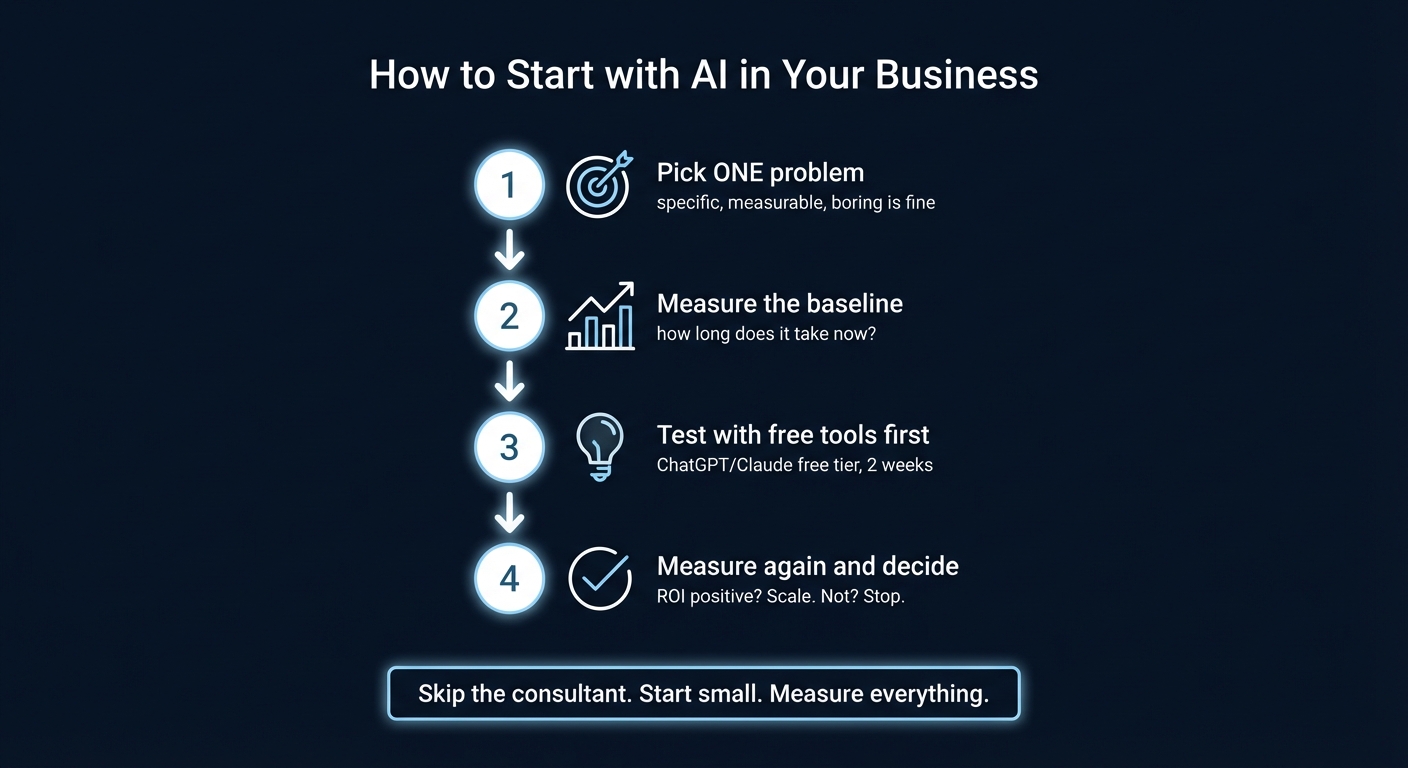
Forget the 50-page implementation plan. Here is the practical playbook that actually works for businesses under 500 employees. I have used this approach myself and seen it succeed in multiple organizations.
Walk through your operations and find the task everyone hates. The one that is repetitive, time-consuming, and error-prone. Data entry from emails. Sorting customer inquiries. Writing weekly status reports. That is your first AI candidate. Not the most impressive project. The most annoying one.
Before touching any AI tool, document the current process. How long does it take? How many errors occur? What does it cost in labor hours per week? This becomes your baseline. Without it, you are flying blind and will never know if the AI actually helped or just felt new and exciting.
Not a 6-month project. Thirty days. One team, one process, one AI tool. Set clear success criteria upfront: we expect to reduce processing time by X hours per week or cut error rates by Y%. At day 30, you either have data that proves value or data that shows it does not work. Both are useful.
If the pilot worked, optimize and expand gradually. If it did not, analyze why and either adjust or move to a different use case. The ability to stop a failing project without guilt is more valuable than any AI tool. Sunk cost is not a strategy. Every month you continue a failing AI project is money better spent elsewhere.
Let me be blunt. A significant portion of the AI consulting industry exists to solve problems you can solve yourself. They will charge you for a discovery phase to identify problems you already know about, build a roadmap full of jargon for things that take 30 minutes to set up, and present it in a slide deck that costs more than the actual implementation.
That said, not all consulting is a waste. There are legitimate scenarios where outside help makes sense.
What you can do yourself:
Setting up ChatGPT, Claude, or Gemini for your team. Building basic automation workflows with tools like n8n or Make. Creating AI-assisted email templates and document drafts. Implementing a customer service chatbot with existing platforms. Running data analysis on your spreadsheets. All of this is learnable in days, not months. The tools are designed for non-technical users. Spending 10,000 euros on a consultant to set up a ChatGPT workflow is like hiring an architect to hang a picture frame.
When outside help actually makes sense:
Custom model training on proprietary data. Integration with legacy enterprise systems. Compliance-sensitive implementations (healthcare, finance, government). Building production-grade AI pipelines that need to handle thousands of requests per hour. These require specialized knowledge that takes years to develop. For these cases, hire someone with verifiable experience in your specific industry, not a generalist who learned AI terminology last quarter.
The best test: ask a potential AI consultant what their last three implementations looked like, including the ones that failed. If they only have success stories, they are either very new or very dishonest. Real practitioners have scars.